

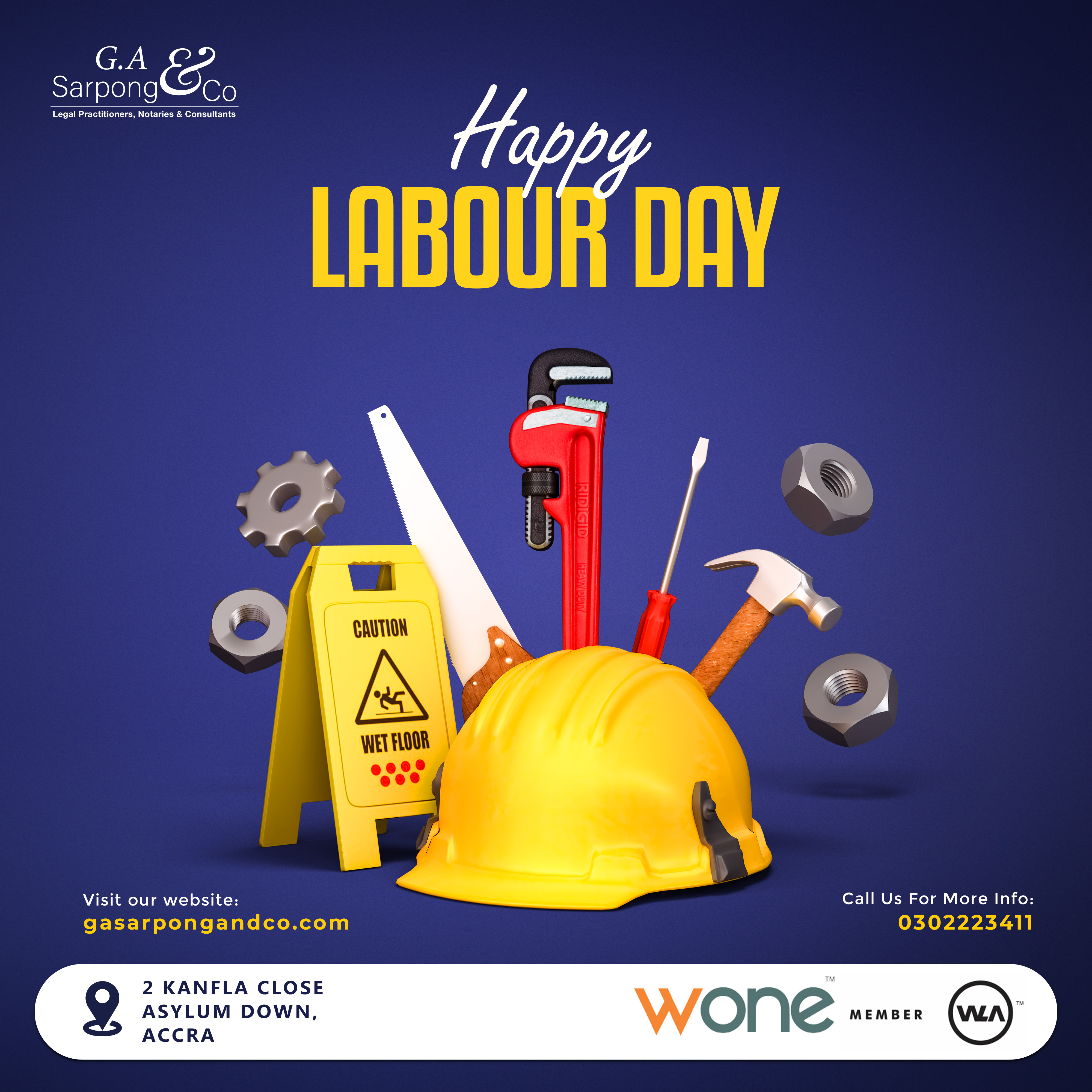
Labour Day in Ghana: Celebrating Workers & Understanding Your Rights Under Ghana’s Labour Laws
Introduction
Every May 1st, Ghana joins the world in celebrating Labour Day—a time to recognize the invaluable contributions of workers and to renew our commitment to fair, safe, and dignified employment. Beyond parades and public holidays, the day offers an opportunity to revisit Ghana’s labour laws, ensuring that both employers and employees understand the rights, responsibilities, and protections enshrined in our legal framework.
1. Origins of Labour Day in Ghana
-
Global Roots: Labour Day (also known as International Workers’ Day) traces back to the 1886 Haymarket affair in Chicago.
-
Ghana’s Adoption: First officially observed in the Gold Coast colony in 1952 under colonial administration, and continued after independence in 1957 as a symbol of unity between labour unions, employers, and government.
2. Key Provisions of Ghana’s Labour Act, 2003 (Act 651)
-
Employment Contracts (Part III):
-
Written contracts mandatory for continuous employment beyond 12 months.
-
Must specify hours, wages, benefits, and termination procedures.
-
-
Working Hours & Overtime (Part IV):
-
Standard: 40 hours/week.
-
Overtime limited to 20 hours/month, paid at 1.5× the regular hourly rate.
-
-
Minimum Wage:
-
Set by the National Tripartite Committee.
-
Reviewed periodically to reflect living costs—currently GHS 14.88/hour (as of 2024).
-
-
Leave Entitlements:
-
Annual leave: at least 15 working days after 12 months of service.
-
Maternity leave: 12 weeks (6 pre-natal, 6 post-natal).
-
Paternity leave: 5 days.
-
-
Health & Safety (Part IX):
-
Employers must provide a safe work environment, protective equipment, and training.
-
Workers have the right to refuse unsafe work without penalty.
-
-
Trade Unions & Collective Bargaining (Part VIII):
-
Freedom of association guaranteed.
-
Unions registered under the Trade Union Act (2003) can negotiate collective agreements.
-
3. Labour Day Celebrations & Activities
-
Parades & Rallies: Major towns host joint marches by labour unions and public-sector workers.
-
Workshops & Seminars: Focused on health & safety, digital skills training, and updates on new labour regulations.
-
Community Outreach: Blood drives, clean-up campaigns, and free legal clinics for under-served workers.
4. Recent Developments & What’s Next
-
Gig Economy Protections: Ongoing discussions to extend basic labour rights (minimum wage, social security) to platform-based workers.
-
Occupational Safety Reforms: The draft Occupational Safety and Health Bill seeks stricter penalties for non-compliance and stronger workplace inspection regimes.
-
Digitalization of Labour Inspection: Pilot programs using mobile apps to report infractions and track inspections in rea- time.
5. What Employers & Employees Should Do Today
-
Employers:
-
Review and update all contracts to comply with Act 651.
-
Conduct regular health & safety audits and training.
-
Engage in good-faith collective bargaining with registered unions.
-
-
Employees:
-
Know your contract terms and entitlements.
-
Report unsafe conditions through established channels.
-
Join a union or worker association to strengthen collective voice.
-
Conclusion
Labour Day is more than a public holiday—it’s a reminder of the social contract between Ghana’s workforce, employers, and government. By understanding and upholding our labour laws, we can build a more productive, equitable, and safe working environment for all.